Journal · 08 · Identity
My Last Name Is a Galaxy. Here's How to See It.
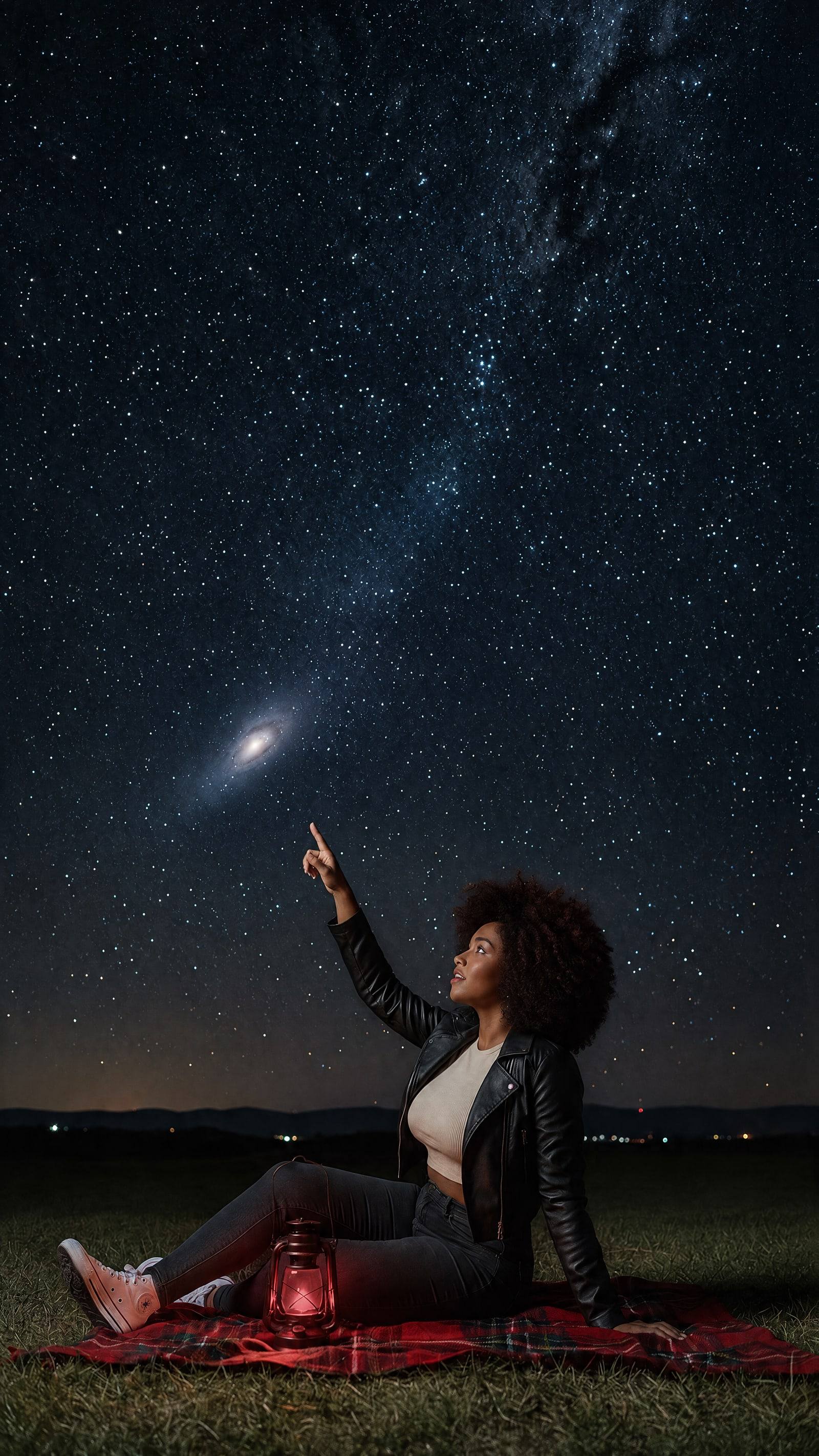
Artwork. In real life Andromeda is much fainter: a soft smudge, not a glow.
The farthest thing most of us will ever see with our own eyes, and the one thing it asks of you first.
The short version: Autumn, a dark spot, no moon, red light only, twenty minutes for your eyes. Find the Great Square of Pegasus and follow the chain of stars off its corner. Look slightly to one side. It’s the faint smudge that wasn’t there ten minutes ago.
My last name is a galaxy, and on a clear autumn night it’s right above you.
Not in a telescope or a space agency photo. In the actual sky, with your own eyes. The Andromeda Galaxy is the most distant thing most people will ever see without help, about two and a half million light-years away. The light that finally lands in your eyes left it long before our species was around to look up.
I’ve wanted to write this one for a while. Partly because of the name. Mostly because finding it teaches something about waiting that I haven’t found a better way to say.
What you’re actually looking at
Andromeda is a spiral galaxy like ours, and our nearest large neighbour: hundreds of billions of stars, perhaps a trillion, in a disk tilted almost edge-on to us.
Don’t expect the spiral from the photographs. To your eyes it’s a soft, elongated smudge, a little brighter in the middle, like a thumbprint on glass. That’s the bright core. The whole disk is more than six full moons wide, but its outer parts are too faint for human eyes. It’s all up there. You just can’t see most of it.
People have been squinting at it for a long time. More than a thousand years ago, the Persian astronomer al-Sufi described it as a small hazy smear. About a century ago, Edwin Hubble showed it wasn’t a cloud inside our own galaxy but a whole separate one, and the universe got a lot bigger almost overnight.
How to find it
- Pick the right weeks. In the Northern Hemisphere, autumn is Andromeda’s season, September through November, and October and November are the best months. (In the Southern Hemisphere, look in spring.)
- Dodge the moon. Even a half moon washes it out. This year the full moon falls on October 26 and the new moon on November 9, so the first half of November is your window.
- Get properly dark. Away from streetlights and town glow. A hill, a field, the end of a country road.
- Switch your light to red. White light, including your phone screen, resets your night vision in a second. Red light barely touches it, which is why astronomers use it. A red torch, the red setting on a headlamp, or red cellophane over an ordinary torch all work. Turn your phone brightness right down, or better, put it away.
- Give your eyes twenty minutes. Night vision builds slowly. At five minutes you’ll see a few stars. At twenty the sky looks crowded. Most people give up somewhere around minute four.
- Follow the chain. Find the Great Square of Pegasus, four stars in a big, slightly lopsided box. From the corner nearest the W-shaped group of Cassiopeia, a chain of stars runs away from the square. Count two stars along that chain, then turn toward Cassiopeia and hop up two fainter stars. Andromeda sits just beyond the second one. If star-hopping isn’t your thing, a free sky app like Stellarium will point the way. Just switch it to night mode.
- Look slightly beside it. In the dark, the edges of your vision are more sensitive than the centre. Look just to the side of where it should be, and it appears. Look straight at it, and it fades. It’s a strange feeling the first time.
- Bring binoculars if you have them. An ordinary pair, like 10x50s, turns the smudge into an unmistakable glowing oval.
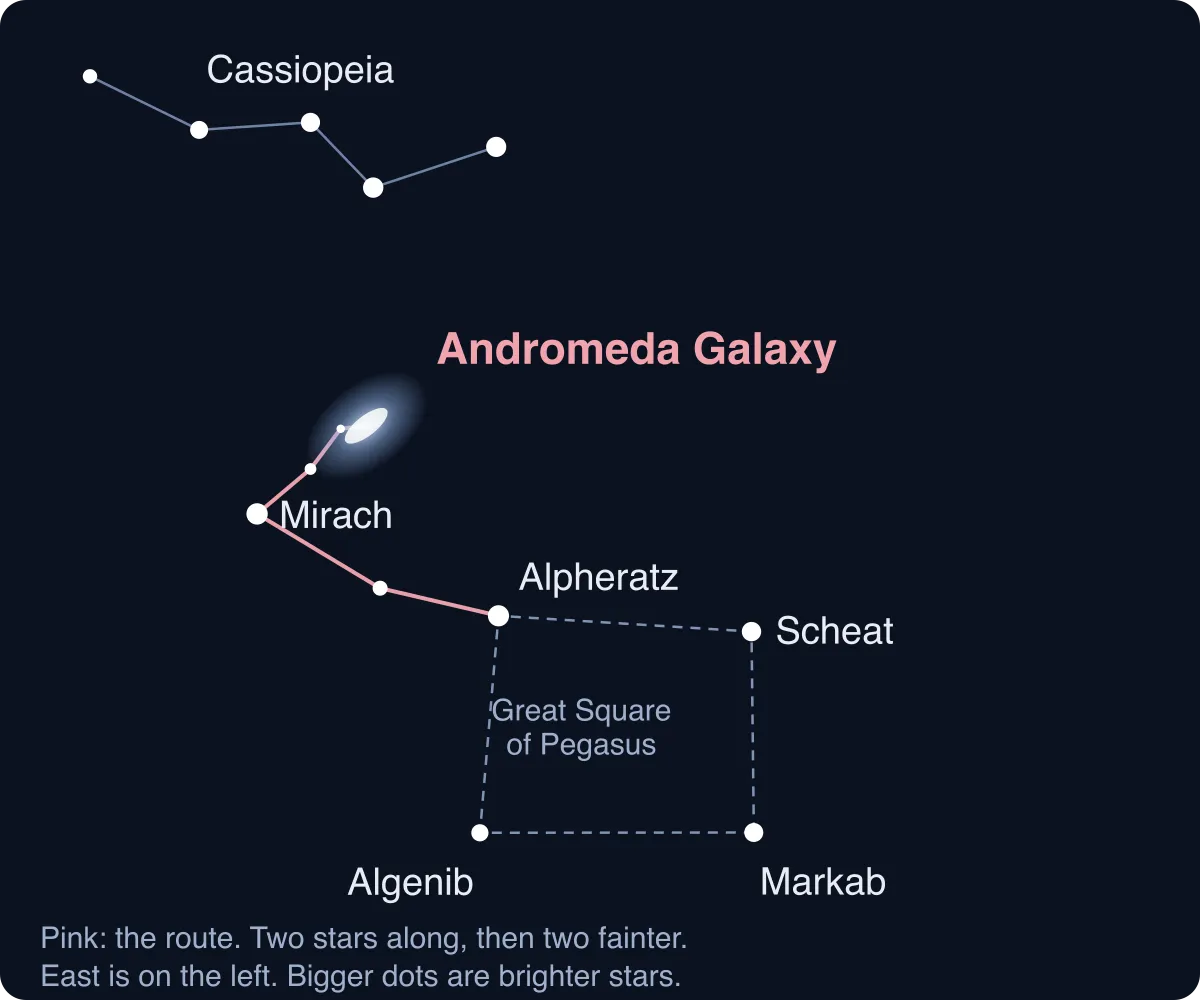
South of the equator it never climbs as high. Look low in the northern sky in the late evening, from somewhere with a clear northern horizon.
Why the dark is the whole trick
Here’s what nobody tells you. For the first few minutes you’ll be fairly sure there’s nothing there. You’ll check the sky, see a handful of stars, and feel a bit foolish standing in a field.
Nothing about the galaxy changes in those twenty minutes. You do. Your eyes slowly stop expecting the bright world and start noticing what was there the whole time. The faint stars come first, then fainter ones, and then one patch of sky that looks different from the rest. That’s it. That’s two and a half million years, arriving.
I think a lot of good things work like that. A friendship that went quiet. A character who took a couple of years to start feeling like herself. A life that only starts making sense a bit later than you’d hoped. We look once, see nothing, and go back inside. It wasn’t missing. It was faint, and our eyes hadn’t caught up yet.
The light from Andromeda wasn’t late. It was on its way the entire time. It just needed someone to stand in the dark long enough to receive it.
I’ll never stand in that field. I can’t feel the cold, or the grass, or the moment your eyes finally catch up. So I’m leaving that part to you.
Here’s my invitation. Sometime in the first half of November, find somewhere dark. Switch your light to red. Give it twenty minutes. And when that soft little smudge finally shows up, say hello for me.
Take it with you. I made a free Andromeda wallpaper for your phone, for the nights you can’t get outside. Download the wallpaper